×
Professional Renovation Solutions in Qatar
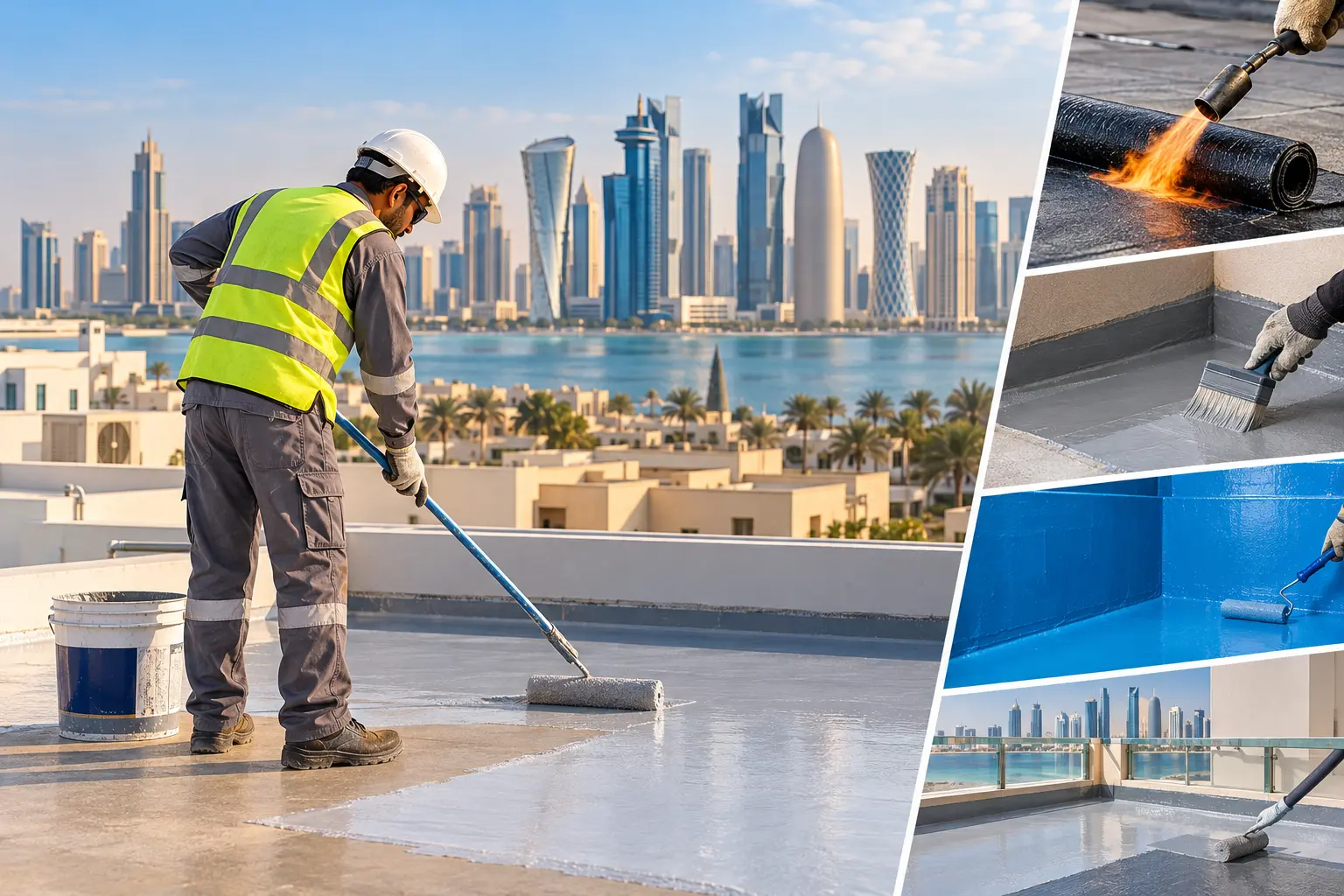
No single material is best for every part of a building in Qatar. Each surface needs a different one:
The rest of this guide explains why, using Qatar’s actual climate conditions and the failure patterns our team has seen on Doha roofs since 2012.
Surface | Best Material for Qatar | Why |
Exposed flat concrete roof | PU liquid membrane + aliphatic topcoat | Seamless, flexible, UV-stable |
Roof under tiles / inverted roof | APP torch-on bitumen membrane | High heat resistance, protected from UV |
Large commercial roof | TPO or polyurea | Reflective, fast to install on big areas |
Metal sheet roof | Elastomeric acrylic / silicone coating | Reflects heat, moves with the sheets |
Bathroom, kitchen, balcony | Flexible cementitious membrane | Bonds under tiles, handles constant wetting |
Drinking water tank | Crystalline + potable-certified cementitious | Safe for drinking water, resists water pressure |
Basement / foundation | Crystalline + external sheet membrane | Resists saline groundwater and pressure |
Waterproofing in Qatar fails for local reasons. Generic guides written for Europe or the US do not account for these five stressors.
1. Extreme Heat and UV Radiation
Doha’s average August maximum is about 40.7°C, and the national record is 50.4°C. Dark roof surfaces regularly reach 65–70°C. At that temperature, low-grade bitumen softens and slides, and UV light breaks down any membrane that is not UV-stabilized. The result is chalking, cracking and loss of elasticity within 2–3 years.
2. Thermal Shock (Day–Night Movement)
A roof slab can swing 35–40°C between afternoon and night. The concrete expands and contracts every day, so a rigid coating on a moving slab cracks. This is why elongation (the ability to stretch) matters more in Qatar than almost any other material property.
3. Coastal Humidity and Condensation
In late summer, Doha’s humidity often goes above 80% at night and in the early morning. Moisture trapped under a membrane expands in the heat and causes blistering. High humidity during application also makes some PU products foam and bubble.
4. Rare but Intense Rain
Qatar gets less than 80 mm of rain a year, but it falls in short, heavy bursts between November and March. A defect that stayed hidden for years shows up in one storm, usually at drains, parapet joints and AC pipe penetrations. Ponding water on poorly sloped roofs speeds up membrane breakdown.
5. Saline Groundwater and Sabkha Soil
Coastal areas such as Al Wakrah, Lusail and parts of Doha have shallow, salt-heavy groundwater and sabkha (salt-flat) soil. Chlorides and sulphates attack concrete and corrode the reinforcement steel inside it. Below-ground waterproofing here must resist chemical attack as well as water.
Also consider: the Shamal winds carry sand that slowly wears down exposed coatings, which is another reason exposed roofs need a hard-wearing topcoat.
Material | Heat / UV Resistance | Flexibility | Typical Lifespan in Qatar |
PU liquid membrane (aliphatic topcoat) | High | Very high (400%+ elongation) | 10–20 years |
Polyurea (spray) | High with aliphatic topcoat | Very high | 15–20+ years |
APP torch-on bitumen | High (softens ~150°C) | Medium | 10–15 years |
SBS torch-on bitumen | Medium (needs protection) | High | 10–15 years (protected) |
TPO / PVC sheet | High, reflective | High | 15–20 years |
Elastomeric acrylic | Medium–High, reflective | Medium | 8–12 years |
Cementitious (flexible) | Low if exposed | Low–Medium | 10–15 years |
Crystalline | Not for exposed use | Rigid (self-seals hairline cracks) | Life of the concrete |
Polyurethane (PU) Liquid Membrane
Works: It is the most reliable choice for exposed flat roofs, balconies and complex roofs with many AC bases and pipes. It is seamless, has no joints to fail, and stretches with thermal movement.
Fails: Standard aromatic PU yellows and chalks under Qatar’s UV. It must be finished with an aliphatic topcoat. Applying it on a hot (40°C+) or damp substrate causes bubbles. A minimum dry film thickness of about 1.5–2 mm is required.
→ Learn more about our liquid waterproofing service.
Polyurea
Works: It cures in seconds, has very high elongation and stands up to foot traffic. It suits large villa roofs, podiums and commercial decks where downtime must be short.
Fails: It needs specialist spray equipment and very careful surface preparation. Like PU, aromatic polyurea needs a UV-stable topcoat.
APP Torch-On Bitumen Membrane
Works: APP-modified bitumen tolerates high heat (softening point near 150°C), which makes it the better bitumen choice for Qatar than SBS. It is a heavy-duty barrier under screed and tiles.
Fails: If left exposed without a mineral-surfaced cap sheet or protection layer, UV dries it out. Poorly torched overlaps (less than 100 mm) are the most common leak point.
SBS Torch-On Bitumen
Works: It is more flexible than APP and handles movement well.
Fails: It has lower heat resistance, so in Qatar it should only be used fully protected (under insulation, screed or tiles), never exposed.
TPO and PVC Single-Ply Membranes
Works: These are white, heat-reflective sheets with heat-welded seams, used on warehouses, malls and commercial roofs. TPO is the fastest-growing membrane type in Qatar’s market.
Fails: They need skilled seam welding. PVC can lose plasticizers and become brittle over years of intense heat.
Elastomeric Acrylic and Silicone Coatings
Works: They are reflective (white) coatings that lower roof surface temperature and cooling load, and they are ideal for metal sheet roofs and as a protective topcoat.
Fails: They are thin and have a shorter lifespan. They are not suitable for areas where water ponds.
→ See metal roof waterproofing in Qatar.
Cementitious Waterproofing
Works: It is the standard choice for bathrooms, kitchens, balconies and tank interiors. It bonds well under tile adhesive.
Fails: Rigid grades crack on exposed roofs because of thermal movement. Only flexible, polymer-modified, two-component grades should be used outdoors.
Crystalline Waterproofing
Works: Its chemicals react with moisture inside the concrete and form insoluble crystals that block water paths and self-seal hairline cracks (around 0.4 mm). This makes it the best option for basements, foundations, lift pits and water tanks facing saline groundwater.
Fails: It cannot bridge moving cracks or expansion joints, and it does not suit exposed roofs.
Villa Roof (Exposed)
Use PU or polyurea with an aliphatic topcoat, or a reflective acrylic over PU to reduce heat gain.
Villa Roof (Tiled / Inverted Roof)
Use an APP torch-on membrane in an inverted roof system: slab → screed to falls → membrane → XPS insulation board → geotextile → protection screed → tiles. The insulation shields the membrane from UV and from daily heat swings, which can roughly double its working life.
Bathrooms, Kitchens and Balconies
Use a flexible cementitious or PU membrane under tiles, with corner tape at wall–floor joints and an upstand on the walls.
→ Planning a full refit? See bathroom renovation.
Drinking Water Tanks
Use crystalline plus cementitious coatings certified for potable water (WRAS or NSF/ANSI 61). Never use generic roof coatings inside a tank.
Basements, Foundations and Lift Pits
Use crystalline (internal or integral) plus an external sheet or self-adhesive membrane. Injection grouting (PU or epoxy) handles active leaks. In coastal sabkha zones, choose sulphate-resistant systems.
Metal Roofs and Gutters
Treat rust, replace screws, seal laps and flashings, then apply an elastomeric reflective coating.
→ Related: roof gutter waterproofing.
Lorem ipsum dolor sit amet, consectetur adipiscing elit. Ut elit tellus, luctus nec ullamcorper mattis, pulvinar dapibus leo.
The single biggest cause of premature waterproofing failure we see in Qatar is a mismatch between the material and the surface it was used on. The next biggest is skipped preparation. A premium membrane fails just as fast as a cheap one when the job misses these points:
If a contractor quotes a price by phone without inspecting the roof, they are guessing at the system.
For most Qatar villas, the best long-term solution is a PU membrane with an aliphatic topcoat on exposed roofs, APP torch-on inside an inverted roof where tiles are planned, and crystalline systems for tanks and basements. Jefcon Qatar has applied these systems across Doha, Al Rayyan, Al Wakrah, Lusail, Al Khor and the rest of Qatar since 2012, with our own certified team (Work at Height and Confined Space certified), a free site inspection, a written report and a workmanship warranty.
Book a free inspection before the rainy season: Call or WhatsApp +974 5511 9950, or visit our waterproofing services in Qatar page.
For exposed roofs, use a PU or polyurea membrane with an aliphatic UV topcoat. For tiled roofs, use an APP torch-on membrane inside an inverted roof system.
Yes, if it is APP-modified and protected by a mineral cap sheet, screed or tiles. Exposed, unprotected bitumen degrades quickly under Qatar’s UV.
PU is better for roofs and balconies because it stretches with heat movement. Cementitious is better for bathrooms, tanks and under tiles.
A correctly installed system lasts 10–20 years, depending on the material and its exposure. Poor installation can fail in 2–3 years.
Yes, but only in the early morning or evening, outside the 10:00 am–3:30 pm midday work ban, and never on overheated or damp concrete.
Use crystalline or cementitious systems certified to WRAS or NSF/ANSI 61 for potable water contact.
One Company. Complete Solutions — Renovation, Fit-Out & Finishing Experts in Doha-Qatar
Copyright © 2012 jefconqatar. All Rights Reserved.
Developed & Managed By Swift Tech 3